
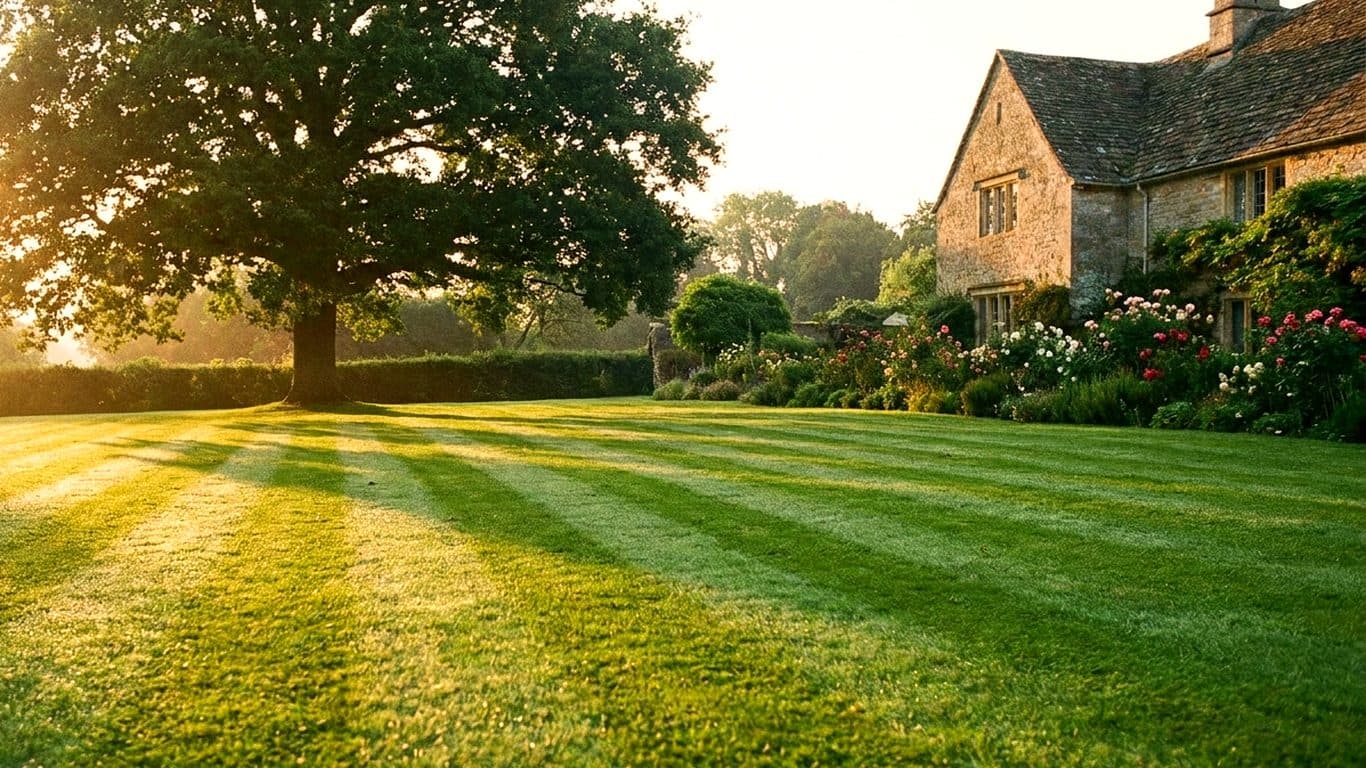
If you garden anywhere around Norwich, you already know a Norfolk summer can’t make its mind up. One week the ground’s like concrete and the lawn’s gone the colour of straw; the next, a thundery downpour rolls in off the coast and everything’s soaked before teatime. A lot of that summer rain arrives in short, sharp bursts rather than steady drizzle (Met Office, no date), which is exactly why gardens round here need a slightly different touch through June, July and August.
I look after gardens across the city and the villages most weeks of the year, so I see how both extremes play out. Here’s how I keep lawns, borders and hedges in good shape through a typical East Anglian summer — the dry spells, the wet ones, and everything in between.
When the sun’s out and the ground’s baked hard
The first thing people get wrong in a hot spell is watering a little bit, often. A quick splash every evening feels caring, but it only wets the top inch of soil and coaxes roots upward to find it — which leaves the whole plant more exposed the moment you stop. A good soak once or twice a week does far more good than a daily dribble, because the water sinks down and the roots follow it (Royal Horticultural Society, no date a). Do it early in the morning or in the evening, too, so less of it steams straight back off in the midday heat.
Lawns worry people most, because they brown off so fast. My honest advice: don’t panic, and don’t reach for the hose. An established lawn that’s gone brown isn’t dead — it’s dormant, and it greens up again within a couple of weeks of proper rain returning (Royal Horticultural Society, no date b). What matters far more is how you cut it. In dry weather I raise the mower blade, cut less often, and never scalp it close, because longer grass shades its own roots and holds moisture better (Royal Horticultural Society, no date b). If the clippings are short I’ll often leave them on the surface as well, where they break down and act as a thin mulch rather than filling another bag.
The things that genuinely do need watering in a heatwave are the newcomers and the containers — freshly laid turf, this year’s bedding, pots and hanging baskets. They haven’t got the root run to fend for themselves yet, so they’re the ones I keep an eye on when a dry fortnight settles in over Norfolk.
When it won’t stop raining
Then the weather flips. After a wet spell the grass practically leaps out of the ground, and it’s tempting to get straight out and mow. Wait for it to dry off first if you can — cutting sodden grass tears rather than slices, clogs the mower, leaves ruts across soft ground and smears clippings everywhere. A day’s patience gives a far cleaner, tidier finish.
Rain brings a few other jobs with it. Borders on our heavier Norfolk clay can sit waterlogged, so I’ll ease off walking on wet beds to avoid compacting them. Slugs and snails have a field day on damp evenings, hostas and young plants especially. And warmth plus moisture is the perfect recipe for weeds and hedges to romp away, so the gap between tidy-ups gets shorter through a muggy Norwich July than it does in a dry one.
Borders, hedges and a bit of feeding
Summer borders reward a little and often. Deadheading — snipping off the spent flowers — keeps roses, dahlias and bedding pushing out fresh blooms instead of setting seed, and five minutes with the secateurs makes a real difference over a season. A feed in early summer gives everything a lift while it’s growing hard.
If there’s one job I’d nudge every gardener towards, it’s mulching the beds. A layer of bark or well-rotted compost over damp soil locks moisture in, keeps the weeds down and saves you watering later on (Royal Horticultural Society, no date c). It’s the closest thing there is to a free afternoon.
Hedges are worth a word of caution in high summer. Bird nesting season runs from March right through to the end of August, and it’s against the law to damage an active nest (RSPB, no date). So before I trim anything in the middle of the season I have a proper look through it first, and if there’s a nest in there the hedge waits. It’s an easy thing to check and it matters.
Going easy on the water
It’s worth remembering where we live. The east of England is the driest part of the country and is classed as seriously water-stressed, with demand pressing hard against what little rain we actually get (Environment Agency, 2025). A hosepipe running over a lawn that would recover on its own is water we can ill afford round here.
Small habits add up. A water butt on the downpipe catches the summer storms for the dry weeks that follow; mulched beds hold onto what they’re given; washing-up or bath water is fine for the borders in a pinch (Royal Horticultural Society, no date a). None of it’s hard work, and it keeps a garden looking cared-for without emptying the mains.
Heading off on holiday?
If you’re away for a couple of weeks in August, a bit of prep saves a lot of heartache. Group your pots together in a shadier spot so they dry out more slowly, give the borders a good soak and a mulch before you go, and — if you can — ask a neighbour to keep the containers ticking over. Come back to a garden that’s coped, not one that’s given up.
None of this is complicated, but it does need doing at the right moment, and summer moves fast once it gets going. If you’d rather someone else kept on top of the mowing, watering and tidying while the good weather lasts, that’s exactly what I do — have a look at what I offer or drop me a message with your postcode and I’ll take it from there.
References
- Environment Agency (2025) Raising the standard for water efficiency in the east of England. Available at: environmentagency.blog.gov.uk (Accessed: 6 July 2026).
- Met Office (no date) Eastern England: climate. Available at: metoffice.gov.uk (Accessed: 6 July 2026).
- Royal Horticultural Society (no date a) Watering plants wisely. Available at: rhs.org.uk (Accessed: 6 July 2026).
- Royal Horticultural Society (no date b) Lawn care for drought conditions. Available at: rhs.org.uk (Accessed: 6 July 2026).
- Royal Horticultural Society (no date c) Mulches and mulching. Available at: rhs.org.uk (Accessed: 6 July 2026).
- RSPB (no date) The Wildlife and Countryside Act 1981. Available at: rspb.org.uk (Accessed: 6 July 2026).